
We recently wrote about how technology companies are staying private longer than at any point in modern venture history here. If you must take one statistic away from the article, it’s this: the median age for US companies at IPO has jumped 50% from 8 to 12 years.
Founders, executives, and investors at these companies are accruing massive paper wealth and increasingly have no clear timeline to liquidity, making this a board-level priority for companies.
The only option that has existed for most of venture history has been a direct secondary sale. However, that’s no longer the best option that exists for sellers.
The Problem
In a direct secondary, a founder sells shares (almost always reflecting a discount to the last round) on the secondary market. Given the in-built opacity of the secondary market, it’s difficult to pinpoint the exact level of discount sellers accept, but the number could be anywhere from 20 – 50% according to most sources.
However, the discount is only part of the equation. When a founder sells outright, they permanently give up participation in future upside. For most venture-backed technology companies, the most valuable period in dollar terms often comes in the last few rounds pre-IPO.
The consequences are visible across public and private markets. Peter Thiel famously lost out on nearly $15bn from selling Facebook (Meta) shares too early. More recently, Stripe raised $6.5 billion at a $50 billion valuation, nearly half its 2021 peak of $95 billion, explicitly to provide liquidity to current and former employees. Shareholders who sold exited at a 47% discount to the prior watermark. Less than three years later, Stripe completed a tender offer at $159 billion. Those who sold in 2023 missed a further 3x…
Beyond economics, the optics create serious challenges. When a founder sells on the secondary market, word travels. Employees question whether leadership still believes. Board members read it as a signal of declining conviction. In a market where founder alignment is a primary criterion for institutional investment, a direct sale can quietly undermine the confidence that sustains a company's valuation.
How Flywheel’s Structured Secondaries Change This
A structured secondary operates on fundamentally different terms. Rather than selling shares outright, the founder enters an arrangement where a capital partner acquires an economic interest through a preferred return mechanism. In our structure, we deploy capital at the current share price (i.e., no discount), collateralised against the founder's existing shareholding.
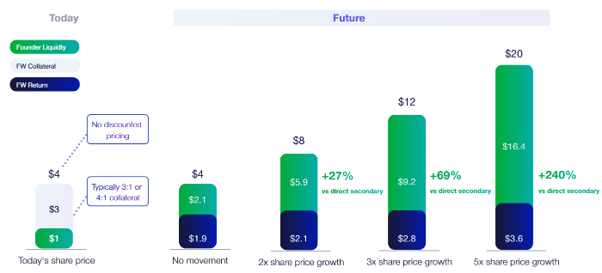
Note: assumes 1.8x preferred return and 5 – 10% participation, and 30% discount for direct secondary.
The founder receives immediate liquidity, typically at or near the last round valuation with no discount, while retaining upside above a contractually agreed threshold.
Consider what this would have meant for a Stripe shareholder in 2023. Rather than selling outright at a steep discount and permanently exiting the position, a structured transaction would have delivered immediate liquidity while preserving the right to participate in the recovery. When Stripe's valuation tripled to $159 billion, the structured shareholder would have captured most of that upside after the preferred return was satisfied.
The direct seller in Stripe received nothing beyond the initial cash and lost out on approximately $10bn of total value.
The Signalling Advantage
The most underappreciated benefit is what a structured transaction communicates. A founder who sells directly is reducing exposure. A founder who enters a structured arrangement is doing the opposite. Because the structure requires the company's value to continue growing for the founder to participate meaningfully in the upside, entering a structured deal is an explicit statement of conviction. The founder is effectively saying: I believe this company will at least double from here, and I am willing to put my economics behind that view.
That signal lands very differently with employees, board members, and co-investors. The narrative goes from "the founder is cashing out" to "the founder structured their liquidity around continued growth."
For founders of category-leading technology companies, the choice between direct and structured liquidity is a strategic decision that affects how every stakeholder on the cap table perceives the company's trajectory.
If this could be of interest to you, please reach out to sam@flywheelcapital.io and we’d be happy to set up a call.